Michał Parniak
Michał Parniak-Niedojadło,
PhD, DSc (habilitation)
email: [email protected]
phone: +48 22 55 43786
room: 00.51
orcid.org: 0000 0002 6849 4671
Google Scholar | ResearchGate | Web of Science | Publications
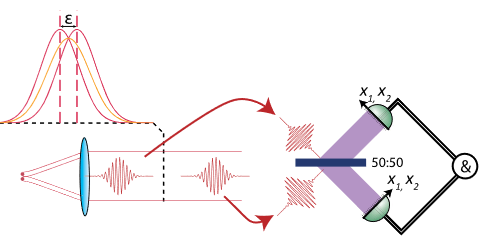
Dr Michał Parniak-Niedojadło is a group leader in the Centre for Quantum Optical Technologies QOT and associate professor at Optics Division, Institute of Experimental Physics, Faculty of Physics. His research interests cover a range of topics in quantum optics, such as single photon detection, optical quantum information processing and communication, atomic ensembles, nonlinear optics and quantum optomechanics. Within QOT he develops experimental implementations of quantum protocols designed by the theory groups and maintains close experimental collaboration with prof. Wojciech Wasilewski (QOT) and prof. Eugene Polzik (Niels Bohr Institute, University of Copenhagen). His most significant scientific achievements include demonstrating superresolution in imaging using two-photon interference, demonstrating the record-breaking quantum memory in terms of its capacity, and demonstration of the first entanglement of macroscopic spin and mechanical systems.
Research Highlights
Hybrid entanglement
Nature Physics 17, 228-233 (2021)
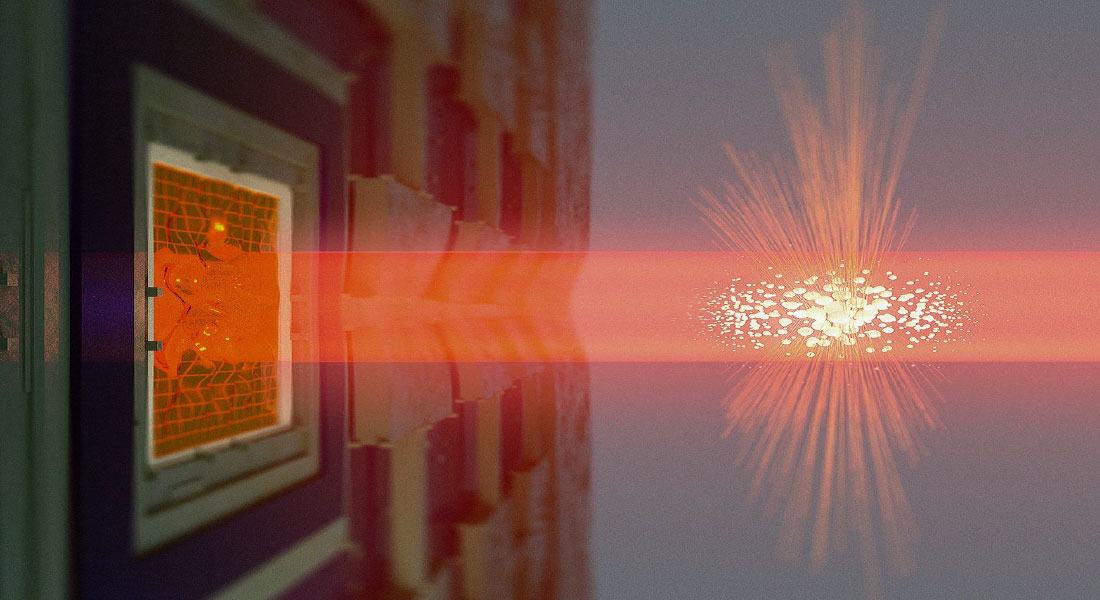
In the experiment performed at QUANTOP (NBI) in the group of Eugene S. Polzik, we entangled a macroscopic mechanical membrane oscillator with an ensemble of room-temperature Cs-atom spins.
Counting of phonons
Optica 7, 718-725 (2020)
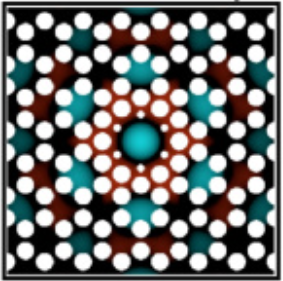
The same phononic-crystal patterned membrane was combined with novel ultra-narrowband cavities to enable thermometry and observation of phonon thermal bunching. The membrane was cooled down to a deep ground state with 0.2 phonons.
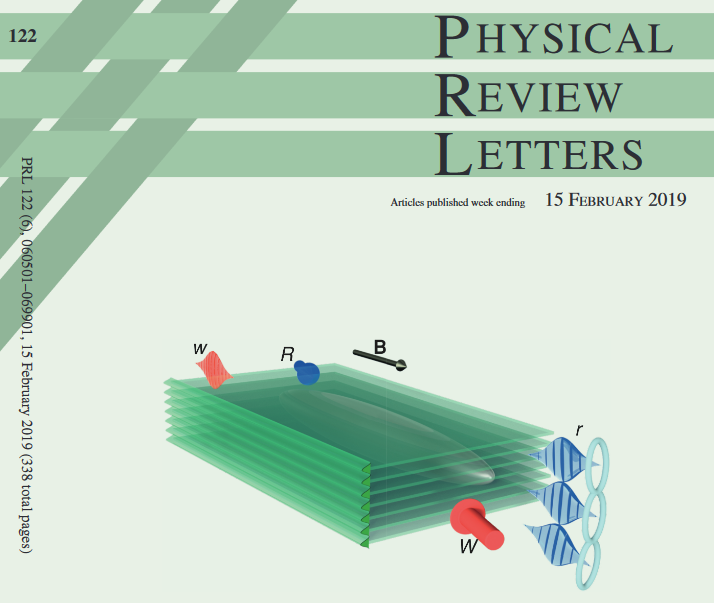
Quantum Optics of Spin Waves
Phys. Rev. Lett. 122, 063604 (2019)
Our experiment highlighted on PRL’s cover, demonstrated the manipulation of light stored as spin waves, and in particular their Hong-Ou-Mandel interference happening in the memory
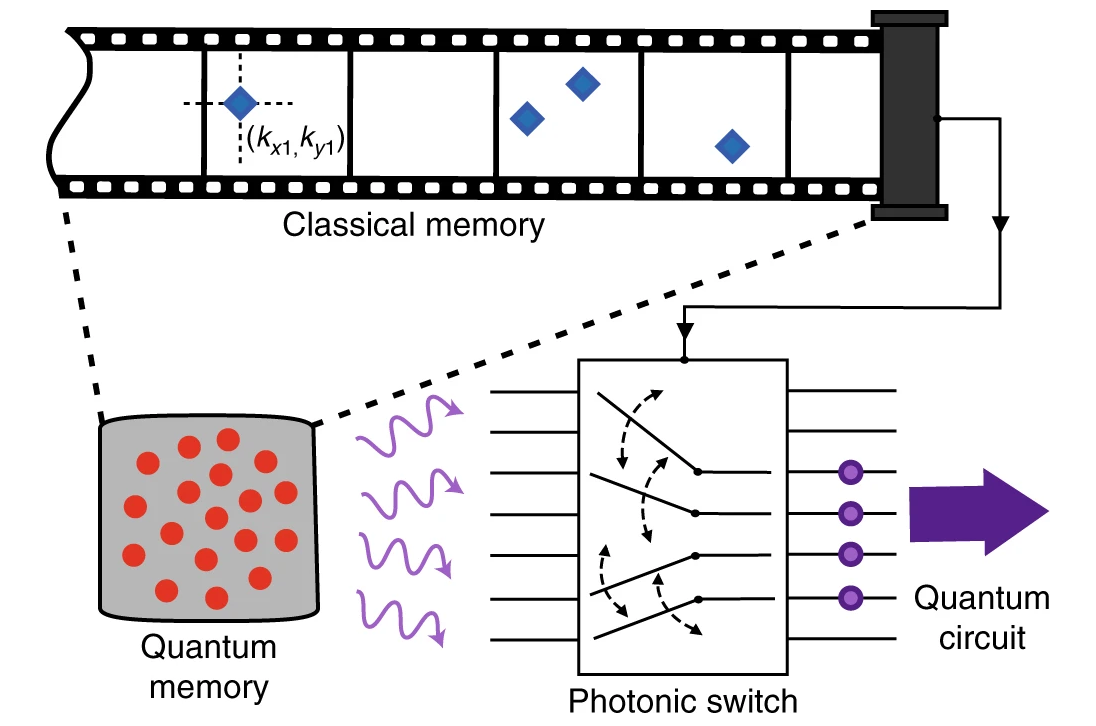
Wavevector-multiplexed memory
Nature Communications 8, 2140 (2017)
In this seminal work, we introduced wavevector multiplexing using a single-photon camera, which allows for a bunch of new protocols and shows incredibly strong quantum correlations with photon counting.
Beating the Rayleigh limit
Phys. Rev. Lett. 121, 250503 (2018)
With Konrad Banaszek and Rafał Demkowicz-Dobrzański, I have shown that via a collective measurement we can enhance multiparameter quantum metrology in a very practical scenario of quantum imaging.