
Research
We build optical quantum devices – sensors, memories and processors of light – and use ideas from quantum information science to make them measurably better than their classical counterparts. Most experiments use rubidium atoms, either laser-cooled or in room-temperature vapour cells, together with optics, electronics and software developed in the lab.
Rydberg-atom sensors of microwave, millimetre-wave and terahertz fields
Atoms excited to high-lying Rydberg states respond strongly to electromagnetic fields from radio frequencies up to terahertz. We use them as receivers that need no conventional antenna, barely disturb the measured field and are calibrated by atomic constants. Recent results include a superheterodyne S-band receiver whose local oscillator is generated inside the vapour cell by an atomic transition loop, an optically-biased receiver based on hybrid nonlinear interferometry, reception of quadrature-amplitude-modulated signals, electric-field metrology of a terahertz frequency comb, background-free imaging of millimetre-wave fields with Rydberg-state fluorescence, and a test bench for 131 GHz automotive radar chips. Using Rydberg interactions we also demonstrated microwave-field quantum metrology that is inherently robust against detection losses.
This line of research continues in the ERC Starting Grant QURA, which aims at quantum sensors that go beyond the limits of classical electronics.
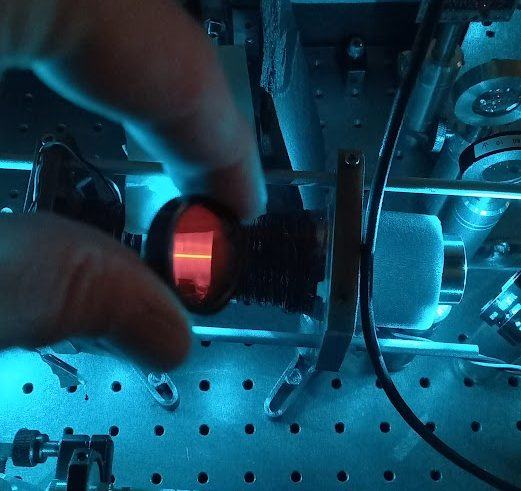
- S. Kurzyna, B. Niewelt, M. Mazelanik, W. Wasilewski, R. Demkowicz-Dobrzański, and M. Parniak, Microwave-field quantum metrology with inherent robustness against detection losses enabled by Rydberg interactions, Nat. Commun. 17, 9013 (2026). doi:10.1038/s41467-026-76016-2
- S. Borówka, M. Mazelanik, W. Wasilewski, and M. Parniak, Optically-biased Rydberg microwave receiver enabled by hybrid nonlinear interferometry, Nat. Commun. 16, 8975 (2025). doi:10.1038/s41467-025-63951-9
- W. Krokosz, J. Nowosielski, B. Kasza, S. Borówka, M. Mazelanik, W. Wasilewski, and M. Parniak, Electric-field metrology of a terahertz frequency comb using Rydberg atoms, Optica 12, 1854 (2025). doi:10.1364/optica.578051
- J. Nowosielski, M. Mazelanik, W. Wasilewski, and M. Parniak, Superheterodyne Rydberg S-band receiver with a multi-tone local oscillator based on an atomic transition loop, Appl. Opt. 64, 5813 (2025). doi:10.1364/ao.557585
- G. Ko, W. Krokosz, M. Mazelanik, W. Wasilewski, and M. Parniak, Background-free calibrated electric-field imaging with Rydberg-state fluorescence and Autler-Townes splitting, Opt. Express 34, 25823 (2026). doi:10.1364/oe.601412
- S. Borówka, W. Krokosz, M. Mazelanik, W. Wasilewski, and M. Parniak, Rydberg-atom-based system for benchmarking millimeter-wave automotive radar chips, Phys. Rev. Appl. 22, 034067 (2024). doi:10.1103/physrevapplied.22.034067
Microwave-to-optical conversion
Converting microwave signals into optical photons connects microwave circuits and sensors with optical fibres and single-photon detectors. Using six-wave mixing in room-temperature Rydberg atoms we built a continuous, wideband converter with no detectable intrinsic noise – sensitive enough to detect thermal radiation and to observe its photon-counting statistics and interference with a coherent microwave.
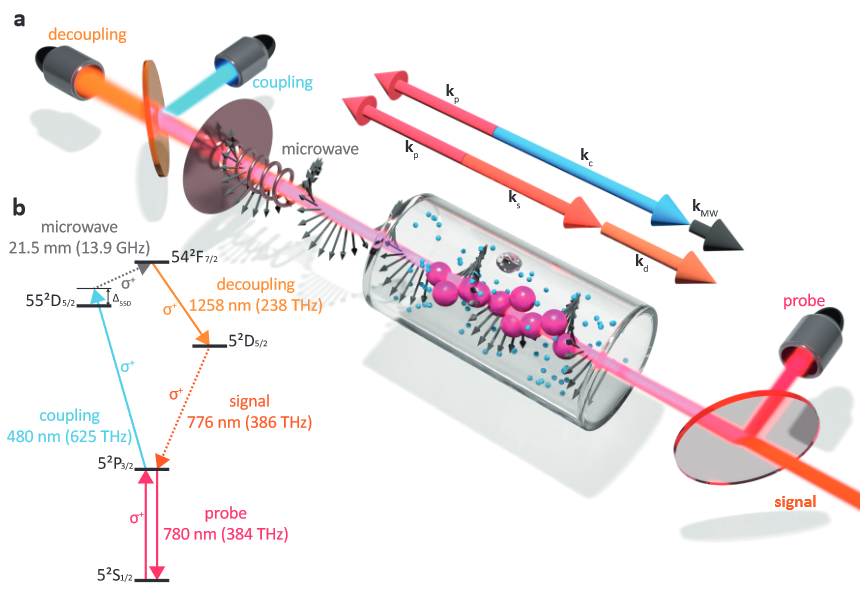
- S. Borówka, U. Pylypenko, M. Mazelanik, and M. Parniak, Continuous wideband microwave-to-optical converter based on room-temperature Rydberg atoms, Nat. Photonics 18, 32 (2024). doi:10.1038/s41566-023-01295-w
Quantum memories and collective Rydberg excitations
Our cold-atom quantum memory stores light as collective spin waves that can be manipulated while stored. We use it for time–frequency processing, spectrum-to-position mapping with programmable spatial dispersion, and a hybrid memory that combines slow light with gradient-echo storage. By modulating an ac-Stark lattice we extended the lifetime of collective Rydberg excitations, a key ingredient for photon–photon interactions and Rydberg-based quantum processing.
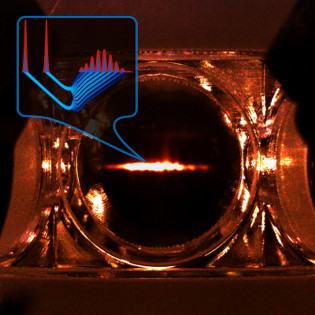
- S. Kurzyna, M. Mazelanik, W. Wasilewski, and M. Parniak, Hybrid quantum memory leveraging slow light and gradient echo duality, Phys. Rev. A 113, 063720 (2026). doi:10.1103/8wzh-jk9z
- S. Kurzyna, B. Niewelt, M. Mazelanik, W. Wasilewski, and M. Parniak, Long-lived collective Rydberg excitations in atomic gas achieved via ac-Stark lattice modulation, Quantum 8, 1431 (2024). doi:10.22331/q-2024-08-02-1431
- M. Jastrzębski, S. Kurzyna, B. Niewelt, M. Mazelanik, W. Wasilewski, and M. Parniak, Spectrum-to-position mapping via programmable spatial dispersion implemented in an optical quantum memory, Phys. Rev. A 109, 012418 (2024). doi:10.1103/physreva.109.012418
Time–frequency processing and super-resolution
Measurements designed with quantum information theory can resolve features beyond the classical Rayleigh limit. We demonstrated super-resolution of ultrafast pulses via spectral inversion, beat the spectroscopic Rayleigh limit with post-processed heterodyne detection, and implemented the optical fractional Fourier transform in the time–frequency domain – both in a quantum memory and electro-optically at the single-photon level.
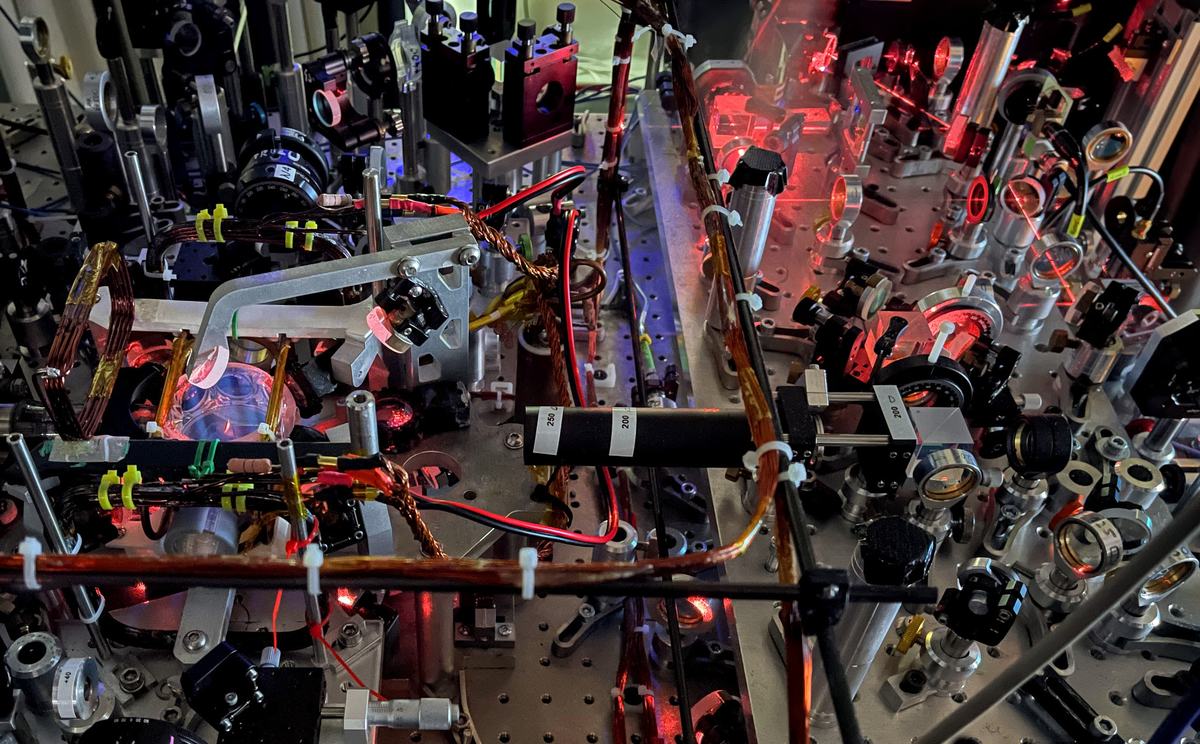
- M. Lipka and M. Parniak, Super-resolution of ultrafast pulses via spectral inversion, Optica 11, 1226 (2024). doi:10.1364/optica.522555
- W. Krokosz, M. Mazelanik, M. Lipka, M. Jarzyna, W. Wasilewski, K. Banaszek, and M. Parniak, Beating the spectroscopic Rayleigh limit via post-processed heterodyne detection, Opt. Lett. 49, 1001 (2024). doi:10.1364/ol.514659
- M. Lipka and M. Parniak, Ultrafast electro-optic time-frequency fractional Fourier imaging at the single-photon level, Opt. Express 32, 9573 (2024). doi:10.1364/oe.507911
- B. Niewelt, M. Jastrzębski, S. Kurzyna, J. Nowosielski, W. Wasilewski, M. Mazelanik, and M. Parniak, Experimental Implementation of the Optical Fractional Fourier Transform in the Time-Frequency Domain, Phys. Rev. Lett. 130, 240801 (2023). doi:10.1103/physrevlett.130.240801
Quantum optomechanics
Together with the group of Eugene Polzik at the Niels Bohr Institute we study mechanical membrane oscillators coupled to light, most recently observing non-classical correlations between photons and phonons of the oscillator's centre-of-mass motion.
- I. Galinskiy, G. Enzian, M. Parniak, and E. S. Polzik, Nonclassical Correlations between Photons and Phonons of Center-of-Mass Motion of a Mechanical Oscillator, Phys. Rev. Lett. 133, 173605 (2024). doi:10.1103/physrevlett.133.173605